
Blog
Red Light Therapy for Neck and Shoulder Tension
Where do you carry your stress?
For most people, the answer is obvious. Their shoulders creep up toward their ears. Their neck gets tight and achy by mid-afternoon. They catch themselves rubbing the top of their shoulders at red lights.
Add in hours at a computer, constant phone use, and the way we all hunch our shoulders against the cold this time of year, and neck and shoulder tension becomes almost universal.
Red Light Therapy has become one of the favorite recovery tools for many of our patients dealing with exactly this.
Why Your Neck and Shoulders Get So Tight
The muscles across the top of your shoulders and the back of your neck, mainly the upper trapezius and levator scapulae, have a demanding job. They help hold up your head, which weighs about 10 to 12 pounds, and they stabilize your shoulder blades every time you use your arms.
Several modern habits overload them:
- Forward head posture from screens and phones, which dramatically increases the load on the neck
- Rounded shoulders from sitting and driving
- Stress, which triggers a protective tensing response in these exact muscles
- Shallow breathing that recruits neck muscles instead of the diaphragm
- Cold weather, which makes us shrug and tense up
- Carrying bags or kids on one side
When muscles are held tense for hours, they fatigue, circulation through them decreases, and they become sore and tender. Trigger points develop, and some people get tension headaches as a result.
How Red Light Therapy Helps Tense Muscles
Red Light Therapy, or photobiomodulation, uses specific wavelengths of red and near-infrared light that interact with your cells, particularly the mitochondria responsible for producing energy.
For chronically tense muscles, that matters in a few ways:
- Cellular energy. Fatigued muscles need energy to relax and recover. Photobiomodulation is studied for its ability to support mitochondrial function.
- Circulation. Better blood flow helps deliver oxygen and clear metabolic byproducts from tight tissue.
- Muscle recovery. Research on photobiomodulation in athletes has looked at reduced muscle fatigue and soreness.
- Relaxation. Many patients find the warmth and quiet of a session genuinely calming, which helps break the stress-tension cycle.
Why Full Body Beats Spot Treatment
Neck and shoulder tension rarely stays in the neck and shoulders. It often involves the upper back, the chest muscles that pull the shoulders forward, and even the low back and hips that affect posture from below.
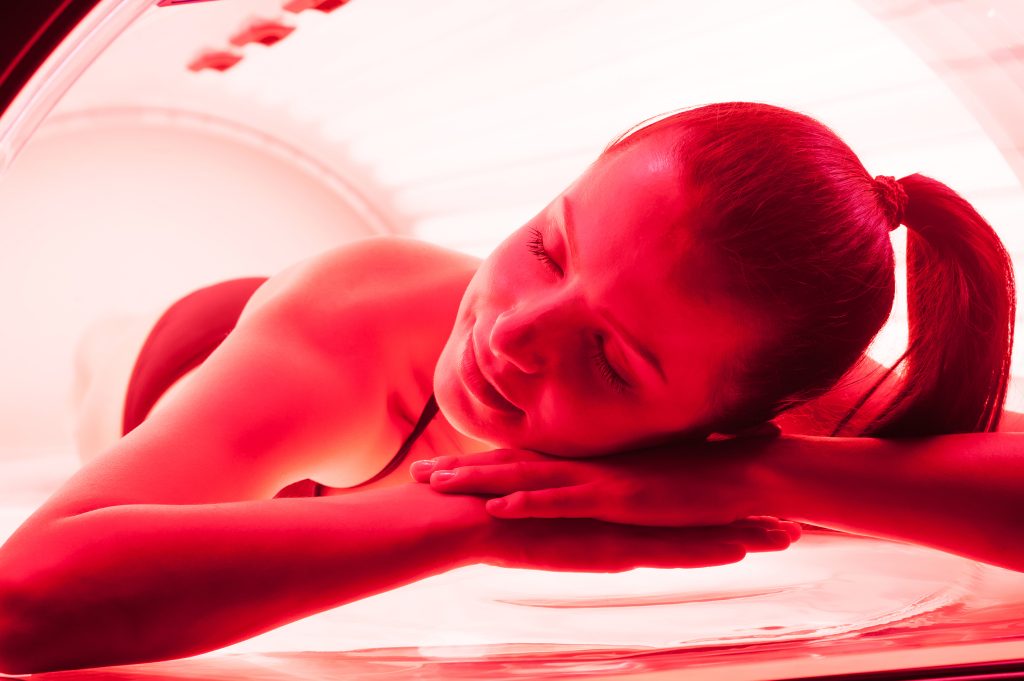
Our Trifecta Pro 450 treats your whole body at once in about 12 minutes, using four wavelengths: 630nm, 660nm, 850nm, and 940nm. Everything gets attention, not just the most obvious sore spot.
And honestly, 12 minutes of lying down in warm light with your phone out of reach might be one of the best things you can do for stress-driven tension.
Ready to unwind those shoulders? Read more on our Red Light Therapy page, or book a session online.
Pair It With Chiropractic Care
Muscles often stay tight for a reason. If the joints of your neck and upper back are restricted, the surrounding muscles guard to protect them.
Chiropractic care addresses those restrictions, restoring motion in the cervical and thoracic spine, the ribs, and the shoulder blades. When the joints move well, muscles have less reason to stay tense.
Many of our patients schedule Red Light Therapy right before or after their adjustment. It is an efficient way to address both the joints and the tissue in one visit.
Daily Habits That Help
- Raise your screens. Monitor at eye level, phone brought up instead of head dropped down.
- Do chin tucks several times a day: gently draw your chin straight back.
- Roll your shoulders back and down every hour.
- Breathe low. Practice slow belly breathing to take the load off your neck muscles.
- Strengthen your upper back. Rows, band pull-aparts, and reverse flies counter rounded shoulders.
- Stretch your chest in a doorway to open up the front of your shoulders.
- Switch sides when carrying bags or kids.
- Manage stress with walks, time outside, and protected downtime.
How Often to Use It
For chronic tension, many people start with three to five Red Light sessions per week, then settle into one to three per week for maintenance. Consistency matters more than any single session.
When Neck Pain Needs Prompt Attention
- Numbness, tingling, or weakness in your arms or hands
- Neck pain after an accident, fall, or impact
- A sudden severe headache, especially the "worst of your life"
- Neck stiffness with fever
- Dizziness, vision changes, trouble speaking, or loss of coordination
- Shoulder or neck pain with chest pain or shortness of breath
These need immediate medical evaluation.
Common Questions
Can Red Light Therapy help tension headaches?
Many tension headaches are driven by tight neck and shoulder muscles. Light may support muscle recovery and relaxation, and chiropractic care addresses the neck joints that often contribute. Frequent or severe headaches should be evaluated.
Is it okay to use a heating pad too?
Yes. Heat at home for short-term relief and regular Red Light sessions work well together.
Should I stretch my neck when it feels tight?
Gentle stretching can help, but if your neck stays tight no matter how much you stretch, restricted joints or weak upper back muscles may be the real issue.
Let Your Shoulders Drop
Chronic neck and shoulder tension is common, but it is not something you have to carry around forever. A combination of chiropractic care, recovery tools like Red Light Therapy, and better daily habits can help you feel looser and lighter.
We help people across North Chili, Chili, Churchville, Spencerport, and greater Rochester let go of the tension they have been holding.
Get a Hold of Us
If you are ready to move better, feel better, and recover faster, our team at Camarata Chiropractic & Wellness is here to help.
New Patient Scheduler Online Here!
Camarata Chiropractic & Wellness
3237 Union Street
North Chili, NY 14514
Follow Us:
Facebook: Camarata Chiropractic & Wellness
Instagram: @camarata_chiro
‹ Back
Recent Posts
-
Red Light Therapy for Neck and Shoulder Tension
November 7, 2026
-
-
10 Simple Health & Wellness Habits to Feel Your Best This November!
November 4, 2026
-

SoftWave for Arthritic Knees and Hands When the Cold Sets In
November 4, 2026
-


 3237 Union St, North Chili, NY 14514

 (585) 617-4145