
Blog
You’re Not Broken… You’re Running the Wrong Program. Understanding the Human Body Through Hardware, Software, and Epigenetics
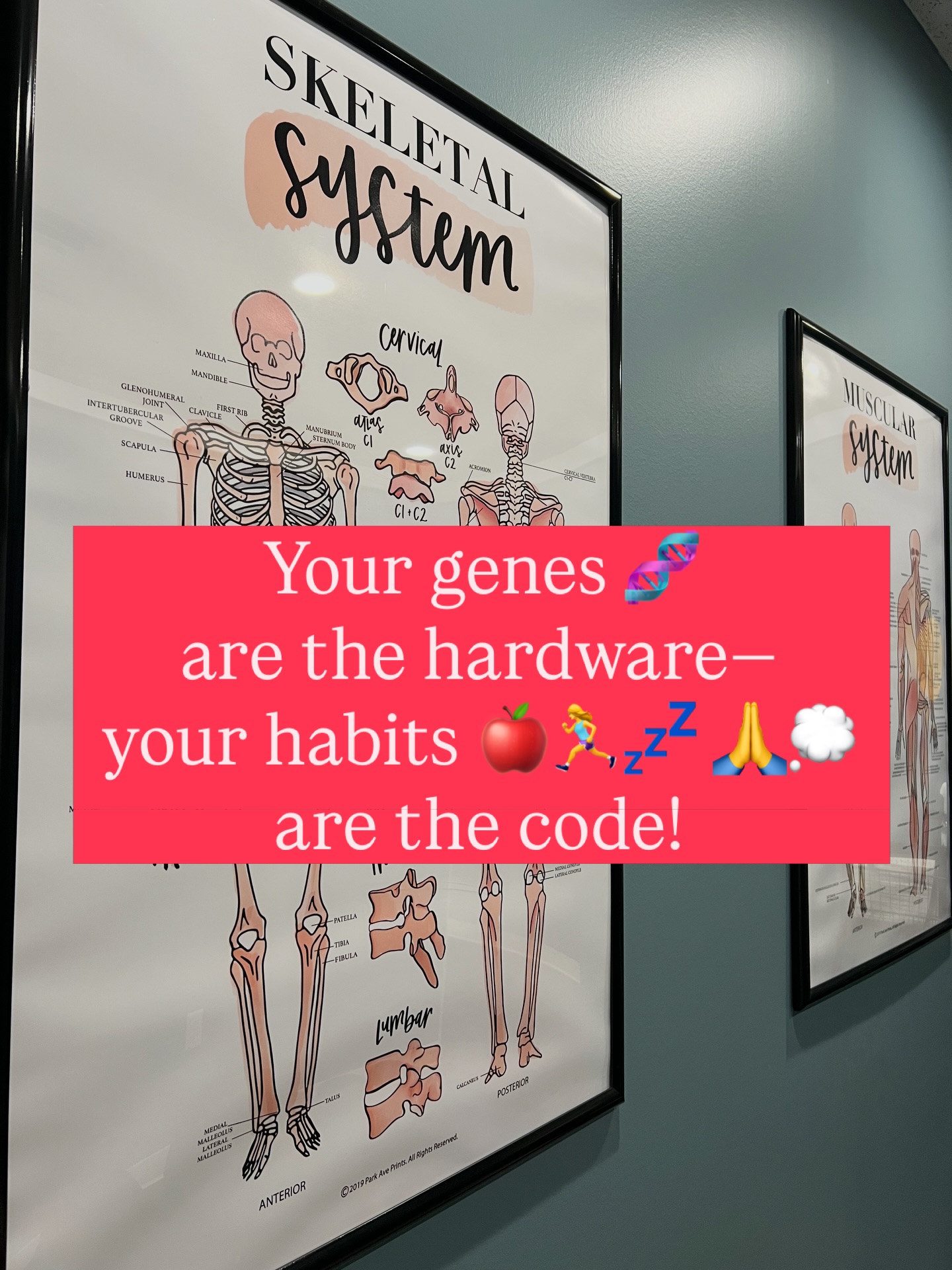
For decades, healthcare has largely focused on diagnosing and treating symptoms at the level of the physical body, the “hardware.” When something hurts, breaks down, or stops functioning properly, the assumption is that the body itself is the problem.
But what if that’s not the full picture?
What if the issue isn’t the hardware… but the software running it?
This is where a deeper understanding of human physiology, the nervous system, and Epigenetics begins to change the conversation entirely.
The Hardware vs. Software Model of the Human Body
Think of your body like a high-performance computer.
- Your organs, tissues, joints, and muscles are the hardware
- Your brain, nervous system, thoughts, habits, and environment are the software
The hardware matters, but the software is what determines how that hardware performs.
If a computer is glitching, freezing, or underperforming, you don’t immediately assume the machine itself is broken. You look at the programs running in the background, the inputs, the processing load, and the system updates.
The same is true for the human body.
Epigenetics: Why Your Genes Are Not Your Destiny
One of the most powerful concepts in modern health science is epigenetics, the study of how behaviors and environment influence gene expression.
Your genes provide a blueprint, but they do not dictate your outcome.
In simple terms:
- Your environment determines which genes are expressed
- Your daily habits are constantly sending signals to your cells
This means your health is not fixed, it is dynamic and adaptable.
You are not a prisoner to your genetics. You are an active participant in how they are expressed.
The Nervous System: Your Master Control System
At the center of this entire process is your nervous system.
Your brain and nervous system are constantly scanning, interpreting, and responding to your environment. Every second of every day, they are processing inputs and making decisions about how your body should function.
These inputs include:
- Nutrition and hydration
- Movement and posture
- Sleep and recovery
- Stress levels and emotional state
- Thought patterns, beliefs, and mindset
Every one of these inputs sends a signal.
And those signals influence everything from:
- Inflammation levels
- Hormonal balance
- Muscle tension and joint function
- Energy production and mitochondrial activity
- Pain perception and healing capacity
Your body is always adapting to the inputs it receives.
When the Software Is the Problem
If your daily inputs include:
- Chronic physical, chemical, or emotional stress
- Poor sleep and inadequate recovery
- Inflammatory nutrition
- Sedentary lifestyle or poor movement patterns
- Negative or fear-based thought loops
Your nervous system interprets this as a threat.
The result?
- Increased inflammation
- Altered movement patterns
- Decreased healing capacity
- Heightened pain sensitivity
- System-wide dysfunction
Over time, this creates a body that feels “broken”, but in reality, it is simply adapting to poor inputs.
Change the Inputs, Change the Output
Here’s the empowering part: the system works both ways.
When you begin to upgrade your inputs, your body responds.
- Better movement improves joint mechanics and neurological feedback
- Proper alignment reduces stress on the nervous system
- Quality sleep enhances recovery and hormone regulation
- Nutrient-dense foods support cellular function and reduce inflammation
- Positive mindset and faith-based grounding reduce stress and improve resilience
This leads to:
- Improved function
- Decreased pain
- Increased energy
- Better performance
- Greater overall health and longevity
Better inputs create better signaling.
Better signaling creates better function.
Better function creates a better life.
A Shift in Healthcare: From Reactive to Proactive
This perspective represents a major shift in how we approach health and wellness.
Instead of asking, “What’s wrong with the body?”
We begin asking, “What inputs is the body adapting to?”
Instead of masking symptoms, we focus on addressing root causes.
Instead of reacting to disease, we prioritize optimization, resilience, and long-term function.
This is where approaches like chiropractic care, movement-based therapies, recovery strategies, and lifestyle optimization come together, to improve both the hardware and the software.
You Are Not Broken
If there’s one message to take away from this, it’s this:
You are not broken.
Your body is incredibly intelligent. It is constantly adapting, responding, and doing its best based on the information it receives.
If the output isn’t what you want, the answer isn’t to give up on your body, it’s to change the inputs.
Final Thoughts: Upgrade Your Program
You don’t need a new body.
You need a better program.
When you take control of your environment, your habits, your mindset, and your daily inputs, you take control of your health.
And that’s where real transformation begins.
Get a Hold of Us
Ready to upgrade your health from the inside out?
At Camarata Chiropractic & Wellness, we focus on identifying the root cause of dysfunction and optimizing your body’s performance through chiropractic care, SoftWave Therapy, recovery strategies, and lifestyle guidance.
Address: 3237 Union St, North Chili, NY 14514
Phone: 585-617-4145
Email: info@camaratachiropractic.com
Online Scheduling Here: https://www.camaratachiropractic.com/appointment-request
Facebook: https://www.facebook.com/camaratachiropractic
Instagram: https://www.instagram.com/camarata_chiro/
Schedule your assessment today. Same-day and same-week appointments are available.
The information provided in this article is for educational and informational purposes only and is not intended as medical advice. Content shared on this website is not meant to diagnose, treat, cure, or prevent any condition. Individual health needs and circumstances vary. Always consult with your healthcare provider or speak with our team at Camarata Chiropractic & Wellness before making changes to your health, nutrition, hydration, exercise, or lifestyle routines.
‹ Back
Recent Posts
-
-
-
Your Child's First Chiropractic Visit: What Parents Can Expect
August 26, 2026
-
Red Light Therapy vs Tanning Beds: What Is Actually Different
August 22, 2026
-


 3237 Union St, North Chili, NY 14514
 (585) 617-4145