
Blog
Scoliosis Screening: What Parents Should Know
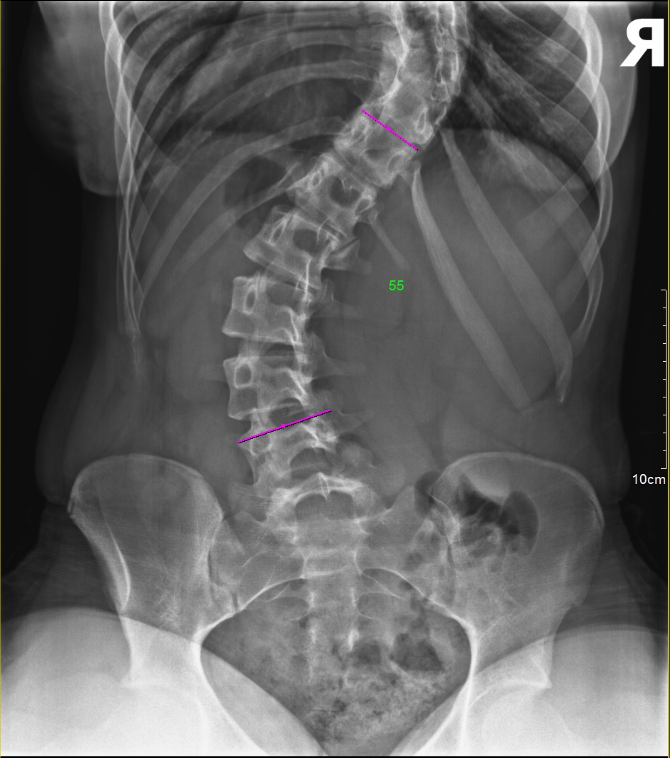
Scoliosis tends to hide in plain sight.
Kids rarely complain about it. It usually does not hurt in the early stages. And it often develops during the exact years when children are least likely to let a parent look closely at their back.
That is why screening matters, and why I want parents to know what to look for.
What Scoliosis Is
Scoliosis is a sideways curve of the spine, usually combined with some rotation of the vertebrae. Seen from behind, a healthy spine runs fairly straight up the middle of the back. A scoliotic spine curves to one side, sometimes in an S or C shape.
A curve is generally classified as scoliosis when it measures 10 degrees or more on an X-ray.
The most common type by far is adolescent idiopathic scoliosis. "Idiopathic" means there is no single known cause, although genetics clearly play a role. It typically appears between the ages of 10 and 15, during the growth spurt before and around puberty.
Why Timing Matters
Curves tend to progress fastest while a child is growing rapidly. Once the skeleton matures, most mild curves stabilize.
That makes the growth years the most important window. A curve caught early can be monitored closely, and if it starts to progress, families have more options. A curve discovered after it has progressed significantly has fewer.
Girls are more likely than boys to have curves that progress, so it is especially worth watching closely in preteen and teen girls.
Signs Parents Can Look For
You do not need special training to spot the most common signs. Look at your child from behind while they stand naturally:
- Uneven shoulders, with one higher than the other
- One shoulder blade sticking out more than the other
- Uneven waist, with a bigger gap between the arm and body on one side
- One hip appearing higher or more prominent
- The head not centered over the pelvis
- Clothes hanging unevenly, or one pant leg seeming longer
The Forward Bend Test
This is the classic screening test, and you can do a simple version at home.
Have your child stand with feet together, then slowly bend forward at the waist with arms hanging toward the floor, like they are diving into a pool. Look at their back from behind, at eye level with the spine.
You are looking for a rib hump: one side of the upper or lower back sitting noticeably higher than the other. That asymmetry comes from the rotation that accompanies a scoliotic curve.
A home check is not a diagnosis, but if you notice an asymmetry, it is worth having a professional take a closer look.
Noticed something, or just want peace of mind? We screen kids and teens for scoliosis as part of our pediatric exams. Book a visit online here.
What Happens After a Positive Screen
If we see signs of scoliosis, the next step is usually imaging to measure the curve accurately. From there, care generally depends on the size of the curve and how much growth remains:
- Small curves are typically monitored with periodic re-checks during growth.
- Moderate curves in growing children are often evaluated by an orthopedic specialist, who may recommend bracing.
- Large or rapidly progressing curves may require surgical consultation.
We coordinate with pediatricians and orthopedic specialists whenever a curve needs medical management. Our role is to support the child, not to replace that care.
Where Chiropractic Fits
I want to be honest with parents here, because there is a lot of misinformation online.
Chiropractic care is not a cure for structural scoliosis. Anyone promising to "straighten" a significant curve with adjustments alone is overselling.
What chiropractic care can do is support how a child's spine and body function around the curve:
- Early detection through regular screening during the growth years
- Improving mobility in stiff areas of the spine, ribs, and pelvis
- Addressing muscle imbalances and discomfort that often accompany curves
- Exercise recommendations to build core strength, balance, and body awareness
- Monitoring between visits with specialists
- Supporting active kids with scoliosis so they can keep playing the sports they love
Will My Child Be Able to Play Sports?
In the vast majority of cases, yes. Most kids with mild to moderate scoliosis stay fully active, and staying strong and active is generally encouraged. If your child plays a high-impact or heavily rotational sport, we can talk through how to support them.
When to Seek Prompt Evaluation
- Back pain that is severe, constant, or wakes your child at night
- Numbness, tingling, or weakness in the legs
- A curve that seems to be changing quickly
- Changes in walking, balance, or coordination
Painful scoliosis in a child is less typical and deserves a thorough medical workup.
Common Questions
Can carrying a heavy backpack cause scoliosis?
No. Heavy backpacks can cause back and shoulder pain, but they do not cause structural scoliosis. Still, keeping backpacks under about 10 to 15 percent of body weight and using both straps is smart for growing spines.
How often should my child be screened?
Kids are most commonly screened during the growth years, roughly ages 10 to 15. If there is a family history of scoliosis, it is worth checking more regularly and starting a little earlier.
A Few Minutes That Matter
Checking your child's back takes less than a minute, and it can catch something important during the years when it matters most.
We are proud to care for kids and families across North Chili, Chili, Churchville, Spencerport, and greater Rochester, from their first steps through their teenage growth spurts.
Get a Hold of Us
If you are ready to move better, feel better, and recover faster, our team at Camarata Chiropractic & Wellness is here to help.
New Patient Scheduler Online Here!
Camarata Chiropractic & Wellness
3237 Union Street
North Chili, NY 14514
Follow Us:
Facebook: Camarata Chiropractic & Wellness
Instagram: @camarata_chiro
‹ Back
Recent Posts
-
-
-

October Unlimited Red Light Therapy Special - ONLY $299!
September 30, 2026
-

Maintenance Care: Why Feeling Good Is the Point, Not the Finish Line
September 29, 2026
-
Round Ligament Pain in Pregnancy: Sharp, Sudden and Usually Normal
September 27, 2026


 3237 Union St, North Chili, NY 14514
 (585) 617-4145