
Blog
The Feel-Good Timeline vs. the Regeneration Timeline: Understanding Your SoftWave Healing Journey
If you are currently receiving or want to experience SoftWave Tissue Regeneration Therapy, there is one concept we want you to understand from the very beginning:
The timeline for FEELING better and the timeline for HEALING, repairing and remodeling are not always the same timeline. Let's dig deeper into this for understanding how your body is feeling, functioning and healing.
This may be one of the most important mindset shifts you can make during your care.
You may have a treatment and feel dramatically better.
Then you work a long day, sleep poorly, play 18 holes of golf, lift weights, sit in the car for several hours, become stressed, eat differently, travel, or simply put more demand on your body than usual...
…and some discomfort returns.
Does that automatically mean you went backward?
No.
Your symptoms are only one piece of a much larger biological picture.
Underneath what you consciously feel, your body is constantly responding to its environment, interpreting neurological information, adapting to stress, regulating inflammation, remodeling tissues and attempting to maintain balance.
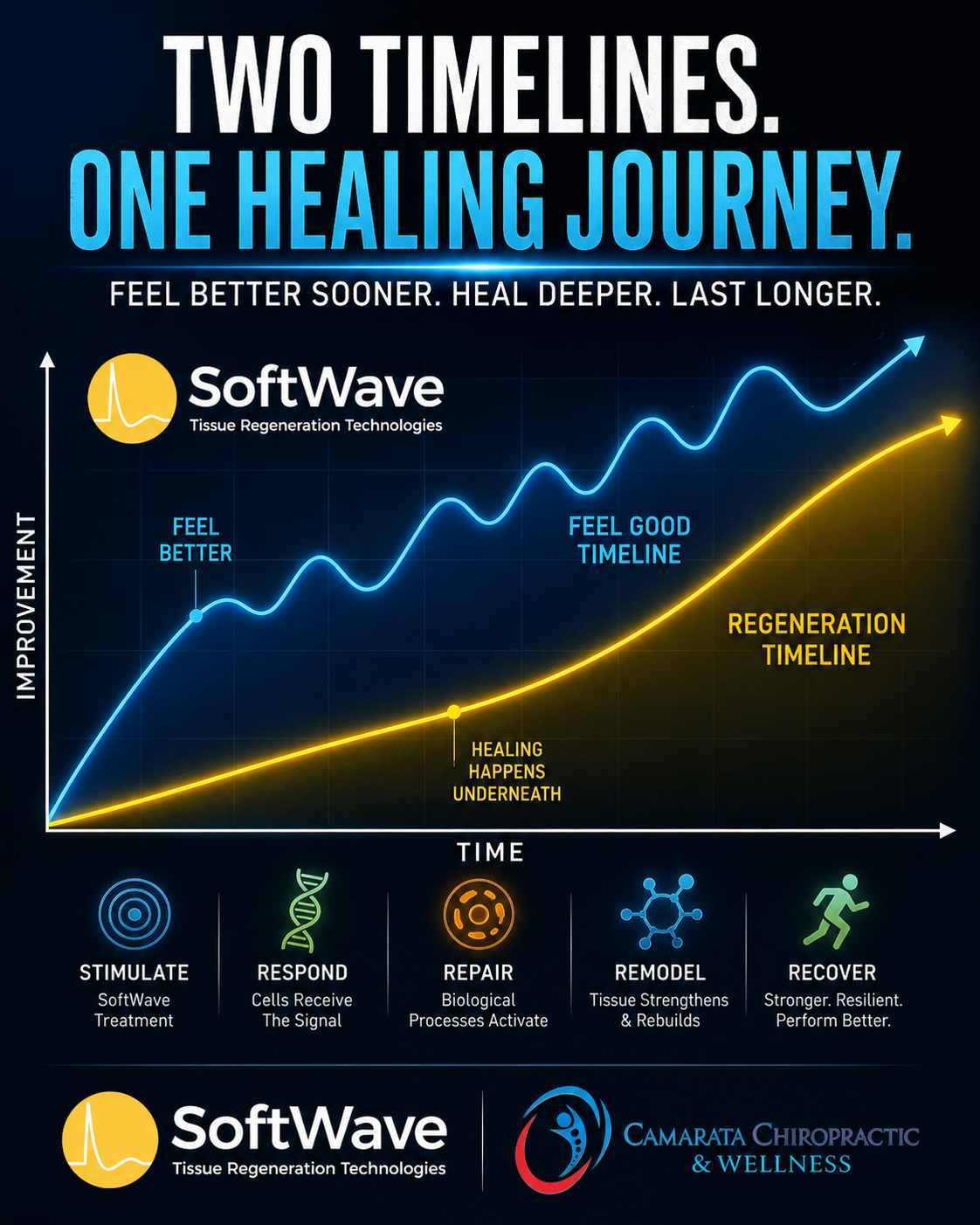
That is why we want our SoftWave patients to understand two different timelines:
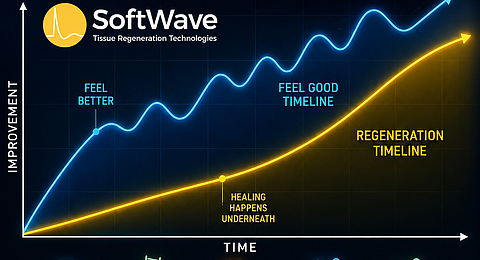
THE FEEL-GOOD TIMELINE
and
THE REGENERATION TIMELINE.
They influence one another, but they don't necessarily move together day by day.
Timeline #1: The Feel-Good Timeline
Think of your symptoms as a dashboard.
Pain, stiffness, soreness, tightness, weakness and sensitivity provide information, but they do not tell the entire story of what is happening inside the body.
Pain especially is much more complicated than simply:
Damage = Pain
Pain is ultimately an experience produced by the nervous system and brain based on enormous amounts of incoming information.
Your nervous system is constantly asking:
"How much protection does this area need right now?"
That decision can be influenced by many factors, including:
-
Tissue irritation or injury
-
Inflammation
-
Previous injuries
-
Repetitive physical stress
-
Sleep quality
-
Emotional stress
-
Fear or anxiety surrounding movement
-
Nutrition and hydration
-
Work demands
-
Exercise and training volume
-
Recovery between activities
-
Sensitivity of the nervous system
-
Your overall health and metabolic environment
This helps explain something we see frequently:
Pain can change faster than tissue can change.
You might feel significantly better before the underlying tissue has completed the repair and remodeling process.
The opposite can also occur.
Positive biological changes may be happening even while you still experience symptoms.
That distinction matters.
Pain Is Not Always a Perfect Measurement of Healing
Imagine someone with chronic knee pain.
They receive SoftWave and their pain decreases dramatically.
They're excited.
So what happens?
They start doing more.
They walk farther. They take the stairs. They exercise harder. They play golf. They work in the yard. They stop protecting the knee because it finally feels better.
Then they wake up sore.
It is easy to think:
"SoftWave stopped working."
But there is another possibility.
Their capacity increased, so their activity increased too.
Their nervous system and tissues are now being exposed to loads they may not have experienced in months or years.
That isn't necessarily failure.
It may simply mean that the feel-good timeline fluctuated while the body continues adapting.
This is why we don't want to evaluate your entire healing journey based on one hour, one day or even one difficult week.
We look at the trend.
Timeline #2: The Regeneration Timeline
This is where SoftWave becomes especially fascinating.
SoftWave Tissue Regeneration Technology uses electrohydraulic acoustic waves that travel through tissue and create a mechanical stimulus.
Cells can respond to mechanical information through a process known as:
Mechanotransduction
Mechanotransduction is the conversion of a mechanical stimulus into biological cellular signaling.
In other words:
Mechanical signal → Cellular response → Biological adaptation
SoftWave isn't simply about temporarily making an area feel different.
The goal is to stimulate biological processes associated with repair, recovery and tissue remodeling.
And many of those processes occur beneath the surface, where you cannot consciously feel them happening.
What's Potentially Happening "Behind the Scenes"?
Research involving extracorporeal shock wave and acoustic wave technologies has explored several biological mechanisms that help explain why improvement may continue over time.
Angiogenesis: Supporting New Blood Vessel Formation
Blood flow matters tremendously for tissue health.
Research has demonstrated signaling involving VEGF, or vascular endothelial growth factor, and eNOS, or endothelial nitric oxide synthase.
These pathways are associated with angiogenesis and vascular function.
Improved vascular signaling may help create an environment more supportive of oxygen delivery, nutrient transport, cellular communication and tissue repair.
You don't consciously feel VEGF increasing.
You don't feel microscopic vascular changes occurring.
But these processes can be part of the biological response happening underneath your symptom timeline.
Activation and Migration of Resident Stem and Progenitor Cells
Another exciting area of regenerative medicine involves the body's own repair cells.
Research suggests shock wave stimulation may influence the activation, recruitment and migration of resident stem/progenitor cells involved in tissue repair.
Think about the significance of that.
Rather than simply asking:
"How do we temporarily turn down pain?"
we can begin asking:
"How can we create an environment that encourages the body to participate more effectively in its own repair?"
That is a completely different mindset.
Modulating Inflammation Rather Than Simply Fighting It
Inflammation has gotten a terrible reputation.
But inflammation itself isn't always the enemy.
Inflammation is part of the body's normal response to injury, stress and repair.
The problem can occur when inflammatory signaling becomes excessive, prolonged or poorly regulated.
Research involving shock wave therapy has demonstrated effects on inflammatory pathways and immune signaling.
The goal isn't necessarily to eliminate inflammation.
It is to help support a healthier progression through the inflammatory and healing process.
Toll-Like Receptors and Cellular Communication
SoftWave research becomes even more interesting when we look deeper into cellular signaling.
Research into extracorporeal shock waves has explored interactions with Toll-like receptors, including TLR pathways, which are involved in innate immune signaling, inflammation and cellular responses to tissue stress.
This highlights something important:
Your body is not a collection of isolated parts.
Your muscles, connective tissues, blood vessels, immune system, nervous system and cells are constantly communicating.
Regeneration requires communication.
Mitochondria, Cellular Energy and Repair
Healing requires energy.
Every repair process occurring inside your body requires cellular resources.
Your mitochondria play an essential role in producing the energy your cells need to function.
Research into mechanotransduction and shock wave therapy has explored effects on cellular metabolism, mitochondrial function and energy-dependent repair processes.
Again, you don't wake up one morning and say:
"Wow, my mitochondria feel amazing today!"
But cellular processes matter.
What happens microscopically eventually influences what happens macroscopically.
Tissue Tensegrity, Elasticity and Load
Your body is an interconnected mechanical system.
Muscles, fascia, tendons, ligaments, bones and joints do not function independently.
They distribute forces throughout the body.
This interconnected relationship is sometimes described through the concept of tensegrity.
Healthy tissues need the ability to:
Load → Absorb → Transfer → Release force
Injury, scar tissue, chronic inflammation, altered movement and repetitive stress can change how those forces move through your body.
As tissue remodels and function improves, we want to improve more than pain.
We want better:
-
Mobility
-
Elasticity
-
Load tolerance
-
Movement quality
-
Strength
-
Coordination
-
Resilience
-
Performance
Because ultimately, the goal isn't simply to hurt less.
The goal is to function better.
Joint Remodeling and Support
Joints are living biological environments.
Cartilage, bone, synovial tissue, ligaments, tendons, muscles, nerves and blood vessels all influence how a joint functions.
Regenerative therapies are exciting because we're beginning to better understand how mechanical signals influence cellular behavior within these environments.
SoftWave may help support biological processes involved in tissue remodeling, circulation and recovery around chronically stressed joints.
This is one reason we frequently use SoftWave for people struggling with chronic knee, hip, shoulder, ankle, foot and other musculoskeletal complaints.
Nerve Support and Recovery
Pain and healing also involve the nervous system.
Preclinical research involving shock wave therapy has investigated its effects on peripheral nerves, including vascularity, nerve regeneration and recovery following nerve injury.
This is especially important because nerves require their own healthy biological environment.
Circulation, inflammation, mechanical stress and surrounding tissue health can all influence nerve function.
Your nervous system is not separate from your healing process.
It is participating in it.
Scar Tissue, Fibrosis and Tissue Remodeling
Scar tissue isn't inherently bad.
It is part of the body's repair response.
But excessive fibrosis or poorly organized tissue can affect mobility, elasticity and force transfer.
Acoustic mechanotransduction has been studied for its potential influence on fibroblast activity, collagen organization and tissue remodeling.
This is another reason improvement may occur progressively rather than instantly.
Remodeling takes time.
Healing Is Rarely a Straight Line
This is the part we want every patient to remember.
Your journey may look something like this:
Treatment → Feel better → Do more → Get sore → Recover → Feel better again → Increase activity → Temporary flare → Adapt → Improve → Repeat
That's life.
And underneath those daily fluctuations, biological adaptation may still be occurring.
Think about it like waves in the ocean.
Your symptoms may rise.
Your symptoms may fall.
Your activity changes.
Your stress changes.
Your sleep changes.
Your workload changes.
But underneath those waves, deeper biological processes continue.
Don't judge the entire ocean by today's wave.
Look at the direction you're moving over time.
Why Repetition Matters
One SoftWave session provides a biological stimulus.
But chronic problems usually didn't develop from one day of stress.
They developed through time + repetition.
Repeated sitting.
Repeated lifting.
Repeated sports.
Repeated injuries.
Repeated poor movement patterns.
Repeated inflammation.
Repeated stress.
Repeated inadequate recovery.
That is why our SoftWave treatment plans typically involve a series of sessions over time.
Think:
Stimulate → Respond → Recover → Remodel → Repeat
We are repeatedly giving the body a stimulus while allowing time for biological adaptation between treatments.
Why Does One Person Respond Faster Than Another?
This is another question we hear frequently.
"My friend felt amazing after two treatments. Why am I taking longer?"
Because you are not your friend.
And we don't want you comparing your healing journey to anyone else's.
Your biology is uniquely yours.
Your nervous system is yours.
Your injury history is yours.
Your lifestyle is yours.
Your sleep is yours.
Your stress is yours.
Your nutritional status is yours.
Your movement patterns are yours.
Your healing capacity is yours.
Two people can have the exact same diagnosis and experience completely different healing timelines.
Comparison creates expectations that biology never promised you.
Instead, compare yourself to yourself.
What can you do now that you couldn't do four weeks ago?
How long can you walk?
How are you sleeping?
How is your mobility?
How quickly do you recover?
How often are you thinking about the painful area?
How much activity can you tolerate?
How frequently are you experiencing flare-ups?
How quickly do those flare-ups settle?
Those are meaningful signs of progress too.
The 3 T's: Physical, Chemical and Emotional Stress
One of the biggest reasons healing timelines vary is the total amount of stress being placed on the body.
We frequently describe stress in three major categories:
1. Physical Stress
Exercise, repetitive work, prolonged sitting, poor ergonomics, injuries, falls, lifting, sports, lack of movement, excessive training and inadequate recovery all create physical demands.
Physical stress isn't automatically bad.
Your body needs appropriate stress to adapt.
The question is whether the stress exceeds your current capacity to recover from it.
2. Chemical Stress
Your body's internal environment matters.
Nutrition, hydration, alcohol, smoking, nutrient deficiencies, metabolic health, highly processed foods, OTC & medications, and other lifestyle factors can influence inflammation, energy production and recovery.
Your cells are constantly responding to the environment you create for them.
What you repeatedly put into your body becomes information your cells must respond to.
3. Emotional Stress
This one is often underestimated.
Work stress.
Financial stress.
Relationships.
Anxiety.
Poor sleep.
Constant stimulation.
Fear surrounding pain.
Feeling overwhelmed.
These experiences can influence the autonomic nervous system, muscle tension, sleep, pain sensitivity, hormones and recovery.
Your brain doesn't live separately from your body.
Emotional stress becomes biological information.
Your Body Is Constantly Adding Up the Inputs
Imagine your body has a daily stress bucket.
Every physical, chemical and emotional stressor adds something to that bucket.
Your recovery practices help empty it.
This is why SoftWave should not be viewed as something that happens only during the few minutes you're in our office.
You live inside your healing environment 24 hours a day.
What happens during the other hours matters tremendously.
Choose Better Inputs
We cannot control every variable in life.
You cannot eliminate every stressor.
You cannot avoid every injury.
You cannot sleep perfectly every night.
You cannot eat perfectly every meal.
And you certainly cannot stop living your life while you're healing.
The goal isn't perfection.
The goal is to consistently create more positive inputs than negative ones.
Move your body.
Eat nutrient-dense foods.
Hydrate.
Prioritize protein and whole foods.
Sleep.
Manage stress.
Spend time outside.
Breathe.
Strengthen your body appropriately.
Recover.
Stay connected to people you love.
Follow your recommended care plan.
Give your body the raw materials, neurological environment and recovery opportunities it needs.
Healing is not something you do once.
It's something you participate in every day.
SoftWave Is a Stimulus. Your Lifestyle Is the Environment.
This may be the most important takeaway from this entire article.
SoftWave provides a powerful mechanical and biological stimulus.
But your body determines how it responds to that stimulus.
And your lifestyle helps shape the environment in which that response occurs.
Think of planting a seed.
The seed matters.
But so does the soil.
The sunlight.
The water.
The nutrients.
The environment.
The consistency.
SoftWave can provide the stimulus.
Your daily habits help create the environment.
Don't Chase a Perfectly Pain-Free Day. Build a More Resilient Body.
Of course we want your pain to improve.
That's often why you came to us.
But our bigger goal is helping you build a body that can move, adapt, recover and tolerate the demands of your life better.
We want you thinking beyond:
"What's my pain level today?"
Start asking:
Am I moving better?
Am I doing more?
Am I recovering faster?
Are my flare-ups becoming less frequent?
Are my flare-ups less intense?
Can I tolerate more activity?
Do I trust my body more?
Am I becoming more resilient?
Those questions tell us much more about the direction of your journey.
Remember the Two Timelines
THE FEEL-GOOD TIMELINE
Can fluctuate daily based on your nervous system, activity, sleep, inflammation, stress and lifestyle.
THE REGENERATION TIMELINE
Represents the biological processes of cellular signaling, vascular responses, tissue repair, adaptation and remodeling occurring over time.
They interact.
But they don't always move together.
So if you experience a difficult day during your SoftWave plan, don't immediately assume you've lost your progress.
Ask:
"What has my body experienced over the last 24–72 hours?"
Look at your sleep.
Your activity.
Your training.
Your workload.
Your nutrition.
Your hydration.
Your stress.
Your recovery.
Then zoom back out and look at the trend.
The Goal: Better Inputs, Better Adaptation, Better Outcomes
Your body is incredibly adaptive.
Every day you're giving it information.
Through movement.
Through food.
Through sleep.
Through thoughts and emotions.
Through exercise.
Through recovery.
Through your environment.
Through therapies such as SoftWave and chiropractic care.
The question becomes:
What instructions are you repeatedly giving your body?
Because health isn't built from one treatment.
It's built through consistent positive inputs compounded over time.
Stimulate.
Nourish.
Move.
Recover.
Adapt.
Repeat.
And give your body something incredibly important that our instant-gratification world often forgets:
TIME.
Because sometimes what you're feeling today is only the surface.
The deeper work may still be happening underneath.
Camarata Chiropractic & Wellness
If you are currently going through a SoftWave treatment plan and have questions about your progress, symptoms, activity level or what you should be doing between treatments, talk with our team.
We want you to understand your care, participate in your recovery and learn how to create a lifestyle that supports better movement, healing, resilience and long-term health.
Don't compare your chapter to somebody else's.
Your body has its own story.
Your nervous system has its own history.
And your healing journey has its own timeline.
Keep choosing better inputs. Keep giving your body the opportunity to adapt. And keep looking at the bigger picture.
Schedule Your SoftWave Therapy Online Here!
Give us a call today! 585-617-4145 | 3237 Union St North Chili NY 14514
Disclaimer: This article is for educational purposes only and is not intended to diagnose, treat, cure or prevent any disease or replace individualized medical advice. Individual responses and treatment timelines vary. Do not change medications, exercise programs or medical treatment without consulting the appropriate healthcare professional. Please speak with our team or your healthcare provider regarding questions specific to your condition.
‹ Back
Recent Posts
-
-
-

SoftWave for Shin Splints: Help for Cross Country and Fall Runners
October 10, 2026
-
-


 3237 Union St, North Chili, NY 14514
 (585) 617-4145