
Blog
How Many SoftWave Sessions Will I Need? An Honest Answer
It is almost always the second question.
The first is "what is SoftWave?" And right behind it comes "okay, so how many sessions am I going to need?"
It is a completely reasonable thing to ask. You want to know what you are signing up for, in time and in commitment.
We are going to give you the honest answer, which includes the parts that are not a tidy number.
The Short Version
Most patients complete a series of treatments rather than a single visit.
The exact number depends on your condition, how long you have had it, your overall health, and how your body responds along the way.
Anyone who quotes you a precise universal number before examining you is guessing.
What we can do is explain exactly what determines that number, so you understand the reasoning behind whatever plan we recommend.
Why It Is Never One Visit
This is the most important concept to understand about SoftWave, and it shapes everything else.
SoftWave does not fix your tissue directly.
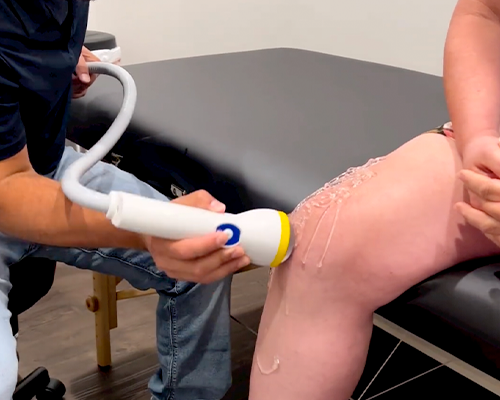
It delivers unfocused acoustic waves that act as a mechanical signal to your cells. That signal increases blood flow, encourages new small blood vessel formation, moves inflammation toward resolution, and prompts your body to recruit its own repair cells to the area.
Then your body does the actual work of repair.
Biology does not work on a single-appointment schedule. Tissue remodeling takes weeks.
Each session reinforces the signal and keeps the process moving. That is why a series works and a one-off usually does not.
It is much closer to a course of physical therapy than to getting a cavity filled.
What Determines Your Number
1. How long you have had it
The single biggest factor.
Something that started three months ago generally responds faster than something you have carried for eight years.
Long-standing tissue changes take longer to remodel. That is just how it works.
2. The tissue involved
Areas with good blood supply respond more readily. Tendons, which have relatively poor circulation, tend to take longer.
3. The severity
Mild irritation and significant degeneration are different starting points.
4. Your overall health
Circulation, blood sugar control, nutrition, sleep, smoking status, and activity level all influence how well and how quickly you heal. Your body is doing the repair, so its general condition matters.
5. Your age
Not a barrier at all, but healing does generally slow somewhat with age.
6. What else is going on mechanically
If a restricted hip is the reason your knee keeps getting overloaded, treating only the knee means fighting an uphill battle. This is exactly why we assess the whole picture rather than just the painful spot.
Ready to feel the difference? Book your appointment online here.
How We Actually Build Your Plan
It starts with an evaluation
Before anyone talks about session counts, we sit down and figure out what we are dealing with.
History, examination, how the area moves, what makes it better and worse, what you have already tried, and what your goals are.
Sometimes that evaluation tells us SoftWave is a strong fit. Sometimes it tells us something else should come first. Occasionally it tells us you need a referral elsewhere, and we will say so.
Then we recommend a starting series
Based on what we find, we lay out a recommended plan with a specific number of sessions and a frequency, and we explain why.
You will know the plan before you commit to it. We are not interested in surprising anyone.
Then we reassess
This part matters.
We are not going to keep treating on autopilot. We check your progress along the way and adjust based on how your body is actually responding.
If you are progressing faster than expected, great. If something is not moving the way it should, we want to know early so we can change course.
What Progress Usually Looks Like
Expectations matter here, so let's be realistic.
Some patients notice change quite early. Others feel very little for several sessions and then notice things shifting.
Both are normal.
Here is what makes it confusing: pain relief and tissue healing are not the same timeline.
You can feel better before the tissue has finished remodeling, which is why we encourage completing the series rather than stopping the moment you feel improvement.
Stopping early because the pain quieted down is one of the most common reasons people end up back where they started.
Signs things are moving
Less pain with the activities that used to reliably trigger it
Better sleep, particularly if the area was waking you
Improved range of motion
Faster settling down after activity
Doing things you had quietly stopped doing
That last one is often the most telling, and patients frequently do not notice it until we ask.
What You Can Do to Need Fewer Sessions
You have real influence here.
Show up consistently. Spacing sessions out too far weakens the cumulative effect.
Keep moving. Appropriate movement supports tissue remodeling. Complete rest does not.
Sleep. Repair happens overnight. This is not optional.
Eat enough protein. You are literally rebuilding tissue.
Hydrate. Every healing process works better hydrated.
Follow the home recommendations. They are not filler.
Address the mechanics. If we recommend chiropractic care alongside it, that is because the mechanical cause is still there.
What About Afterward?
Once you complete a series and reach a good place, most people do not need ongoing treatment for that issue.
Some patients with long-standing chronic conditions choose occasional maintenance sessions, in the same way people do with chiropractic care.
Others come back only if something flares up again.
That is a conversation we have at the end based on your results, not a subscription you get locked into at the beginning.
Come Find Out What Your Plan Looks Like
We know the honest answer of "it depends" is less satisfying than a number.
But we would rather examine you and give you a real recommendation than quote a figure that means nothing for your particular situation.
The evaluation is where you get your actual answer, along with a straight assessment of whether we think we can help you at all.
You can learn more about our regenerative services at www.NaturalHealingROC.com.
We treat patients from North Chili, Chili, Churchville, Spencerport, and throughout the greater Rochester area.
Come in, and we will give you a clear plan rather than a vague promise.
Get a Hold of Us
If you are ready to move better, feel better, and recover faster, our team at Camarata Chiropractic & Wellness is here to help.
New Patient Scheduler Online Here!
Camarata Chiropractic & Wellness
3237 Union Street
North Chili, NY 14514
Follow Us:
Facebook: Camarata Chiropractic & Wellness
Instagram: @camarata_chiro
‹ Back
Recent Posts
-
How Many SoftWave Sessions Will I Need? An Honest Answer
August 24, 2026
-
Red Light Therapy vs Tanning Beds: What Is Actually Different
August 22, 2026
-
-

-


 3237 Union St, North Chili, NY 14514
 (585) 617-4145