
Blog
SoftWave for Groin and Hip Flexor Strains: Hockey, Soccer and Sprinters

Hockey season is underway. Indoor soccer is starting up. Winter track athletes are getting back into sprint work.
And right on schedule, we are starting to see groin and hip flexor strains.
These injuries have a reputation, and it is deserved. They are easy to get, hard to shake, and quick to come back if they are not handled well. Many athletes end up playing at 80 percent for months because the groin "never quite feels right."
It does not have to go that way.
Groin vs Hip Flexor: What Is the Difference?
A groin strain usually involves the adductors, the muscles on the inside of your thigh that pull your legs together. They work hard in skating, cutting, kicking, and changing direction.
A hip flexor strain involves the muscles at the front of the hip that lift your thigh, mainly the iliopsoas and the rectus femoris. They are heavily loaded in sprinting, kicking, and high knee drive.
Both live close together, both get hurt in similar sports, and in practice athletes often have some of both.
Who Gets Them
- Hockey players, because of the wide, powerful skating stride
- Soccer players, with kicking and quick cuts
- Sprinters and hurdlers
- Football players, especially skill positions
- Martial artists and dancers
- Weekend warriors jumping into sports without a proper warm-up
Why They Linger
The groin and hip flexors are used in nearly every athletic movement and many everyday ones, like walking and getting in and out of the car. That makes them hard to truly rest.
They also tend to recur because:
- Athletes return when pain fades rather than when strength is restored
- Adductor strength is often not specifically retrained
- Stiff hips and a restricted pelvis keep overloading the healing tissue
- Scar tissue and chronic tension limit how the muscle lengthens
- Core weakness puts more demand on the muscles around the pelvis
Signs of a Groin or Hip Flexor Strain
- Sharp pain in the inner thigh or front of the hip during a sprint, kick, or cut
- Pain squeezing your knees together
- Pain lifting the knee toward the chest
- Tenderness in the groin or front of the hip
- Bruising in more significant strains
- Stiffness and pain getting going, especially the next morning
How SoftWave Helps
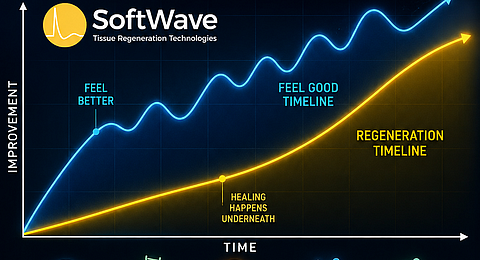
SoftWave Tissue Regeneration Technology uses broad-focused acoustic waves to stimulate tissue at a cellular level. It is FDA cleared, non-invasive, and has no downtime, so athletes can keep up with school, work, and lighter training.
For groin and hip flexor strains, SoftWave can help:
- Improve circulation to support repair of the muscle and tendon
- Address scar tissue and chronic tension that limit flexibility
- Calm lingering irritation where the muscle attaches near the pelvis
- Reduce pain so athletes can progress their rehab
Because SoftWave covers a broad area, we can treat the adductors, hip flexors, and surrounding tissues together, which is ideal since these injuries rarely stay in one muscle.
Groin still not right? Book a SoftWave consultation online, and coaches can see our team program at camaratachiropractic.com/sports.
Chiropractic: The Pelvis Matters
Your adductors and hip flexors both attach to the pelvis. When the pelvis, sacroiliac joints, hips, and low back are not moving well, these muscles take on extra strain.
At Camarata Chiropractic & Wellness, we evaluate and restore motion through:
- The pelvis and sacroiliac joints
- The hip joints
- The lumbar spine
- The knees and ankles, which affect how force travels up the leg
Balanced pelvic motion takes pressure off the healing tissue and helps prevent the next strain.
The Rehab Progression
- Isometric squeezes, like squeezing a ball between your knees, to start loading the adductors safely
- Copenhagen planks, progressed carefully, which have strong support for groin injury prevention in hockey and soccer
- Hip flexor strengthening, like standing knee drives and marches
- Core work to stabilize the pelvis
- Lateral movement, skating, and cutting drills before full return
- Sprinting and kicking progressions as the final stage
A good benchmark is that squeezing strength on the injured side should closely match the healthy side before returning to full play.
Prevention Tips
- Warm up with dynamic hip and groin movements
- Include adductor strengthening year-round, not just after injury
- Increase sprinting and skating intensity gradually
- Stay on top of hip mobility
- Listen to early tightness instead of pushing through
When to Get It Checked Promptly
- A pop with immediate significant pain or difficulty walking
- Large bruising or swelling
- Groin pain with a lump, especially with coughing or straining, which could be a hernia
- Deep hip pain with clicking or catching
- Groin pain in a teen that does not improve, which may involve the growth plate
Common Questions
Is a groin strain the same as a sports hernia?
No. A groin strain involves a muscle or tendon, while a sports hernia, sometimes called athletic pubalgia, involves the attachments around the lower abdomen and pubic bone. They can feel similar, which is why persistent groin pain deserves a thorough exam.
Can I keep skating or playing while it heals?
Sometimes, with reduced intensity, if it is mild and not getting worse. Pushing through a significant strain usually extends the recovery.
Do Copenhagen planks really help?
Yes. Studies in soccer and hockey have shown adductor strengthening programs like the Copenhagen plank can reduce groin injuries. Start with an easier variation and progress gradually.
Get Back to Full Speed
Groin and hip flexor strains do not have to drag on all season. Treat the tissue, fix the mechanics, and rebuild the strength, and most athletes get back to full speed with confidence.
Learn more at www.NaturalHealingROC.com. We help hockey players, soccer players, and sprinters across North Chili, Chili, Churchville, Spencerport, and greater Rochester.
Get a Hold of Us
If you are ready to move better, feel better, and recover faster, our team at Camarata Chiropractic & Wellness is here to help.
New Patient Scheduler Online Here!
Camarata Chiropractic & Wellness
3237 Union Street
North Chili, NY 14514
Follow Us:
Facebook: Camarata Chiropractic & Wellness
Instagram: @camarata_chiro
‹ Back
Recent Posts
-
-

Red Light Therapy for Plantar Fasciitis and Foot Pain
October 25, 2026
-
-

-
World Spine Day: Five Daily Habits for a Healthier Spine
October 16, 2026


 3237 Union St, North Chili, NY 14514

 (585) 617-4145